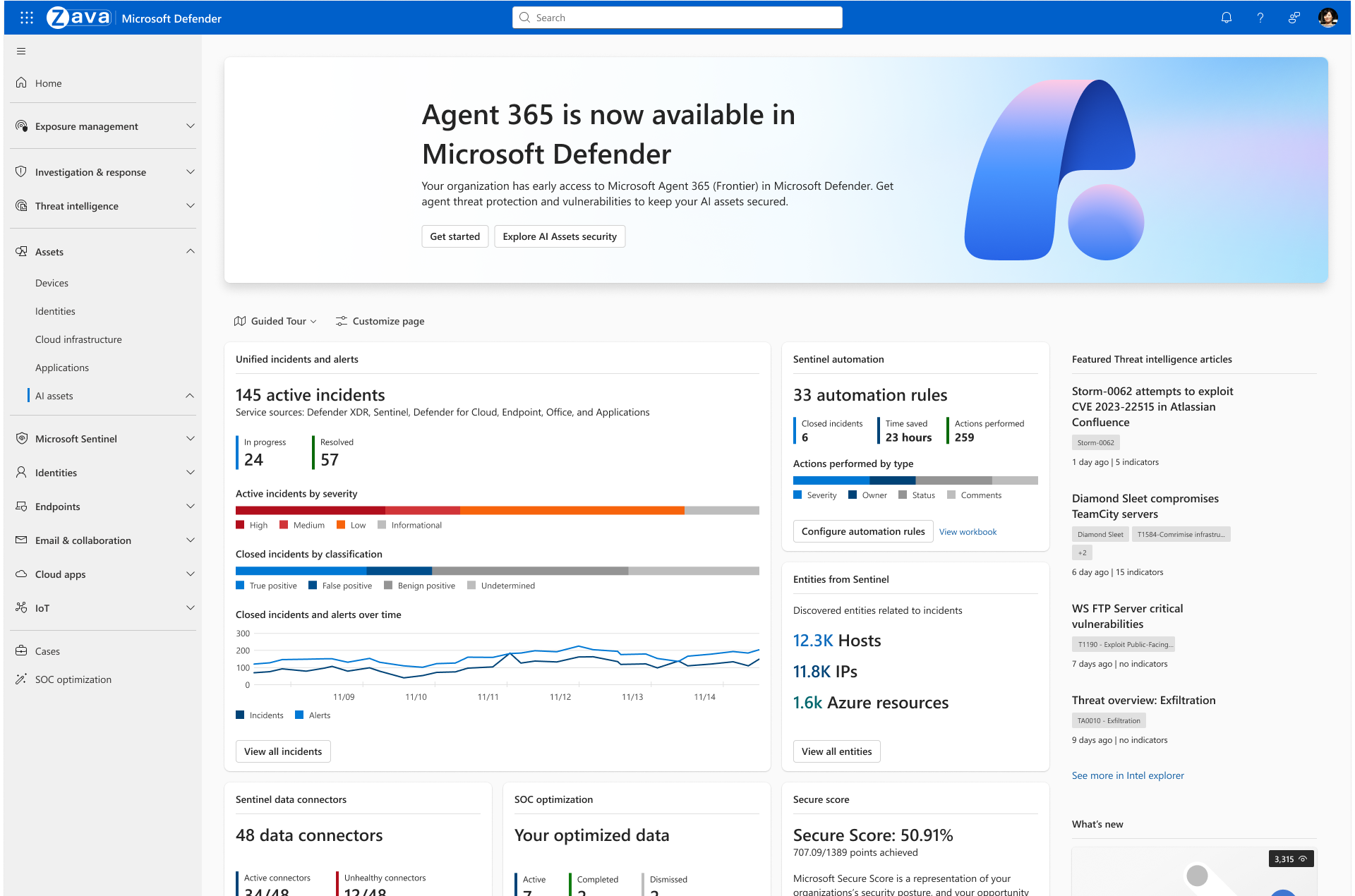
Scaling content design with AI across Microsoft Security
Role: Content designer
Overview
I developed a scalable content strategy for Agent 365, aligning messaging to help IT admins confidently manage and secure AI agents across Microsoft 365.
Skills: Content strategy, content design, AI-assisted workflows, design systems, terminology strategy, cross-functional collaboration
Audience: Enterprise Microsoft Security customers and internal product teams building Agent 365 security experiences
Tools: Figma, GitHub Copilot CLI, GitHub, Microsoft 365 suite
Platforms: Microsoft Entra, Defender, Purview, Security for AI, Microsoft 365 admin center
Collaborators: 2 product designers, 1 content designer, 50+ cross-functional partners, including content designers, product managers, product marketing managers, and engineers, across Microsoft Security and Microsoft 365 admin center
Problem
As Agent 365 capabilities expanded across Microsoft Security, teams across Entra, Defender, Purview, and Security for AI began communicating Agent 365 value in different ways. Because Agent 365 was owned by a different team, there was no unified strategy connecting experiences across Microsoft Security products.
At the same time, upcoming licensing changes meant customers using Agent 365 capabilities across Microsoft Security products through our preview program would need to purchase a license to maintain access. Teams needed a consistent approach for communicating Agent 365 value and licensing changes across multiple platforms.
Strategy
Creating a unified Agent 365 content strategy
I partnered with content designers across products to develop a content strategy that included:
Defining messaging principles to support clear, responsible AI communication
Establishing terminology guidance to create consistency across products
Developing reusable UX content patterns for common user scenarios
Designing a scalable way to share content guidance
Traditional content strategy guidance was often shared through large Figma files. While preferred for UX professionals, these formats were less accessible for PMs, engineers, and other partners who needed access to this guidance.
To increase adoption, I created an interactive HTML framework that transformed static guidance into a self-service resource. The framework included:
Interactive decision tree to help teams determine when and where Agent 365 messaging should appear
Content guidance with terminology, examples, and anti-patterns
Cohort frameworks for different customer journeys
I used GitHub Copilot CLI to accelerate development of the framework, allowing me to quickly prototype and deliver a more accessible resource than traditional documentation.
Scaling through AI
The next challenge was extending content strategy beyond what a small content design team could manually support.
We transformed the Agent 365 guidance into an AI-accessible skill stored in our GitHub repository. This allowed teams using GitHub Copilot CLI to access content strategy recommendations directly within their workflows. This created a new model for content design where content designers define the strategy, and AI helps scale that strategy.
Instead of relying on individual content designers to review every experience, teams could use AI tools to apply established guidance consistently.
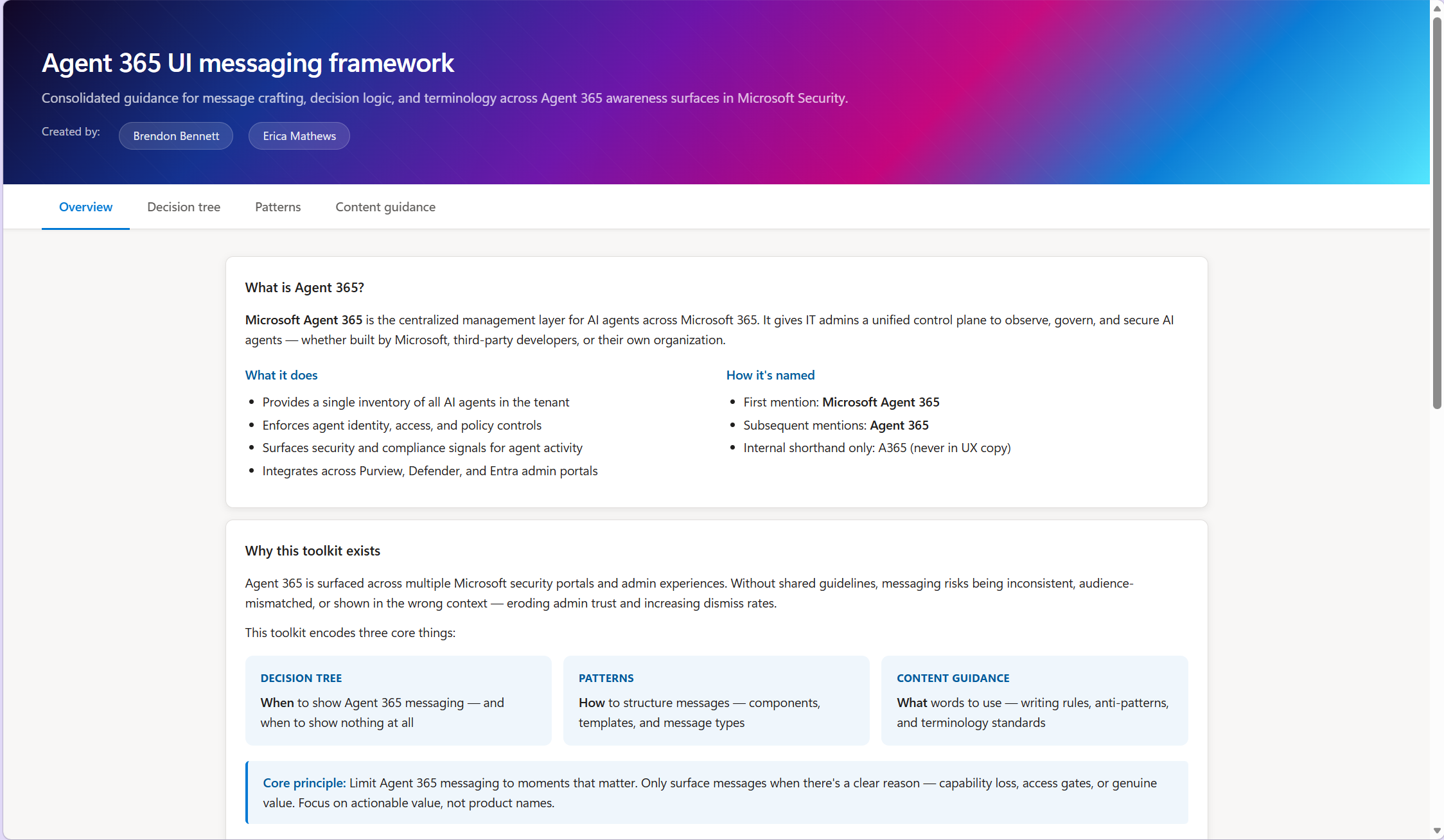
Interactive framework
I built this interactive framework using GitHub Copilot CLI for partners across Microsoft Security. A version for AI tools could also be accessed as a skill from this page.
Impact
This work established a unified Agent 365 content strategy across Microsoft Security and improved alignment across product organizations. Outcomes included:
Created consistent Agent 365 messaging across five Microsoft Security platforms
Aligned Microsoft Security teams with the Microsoft 365 admin center
Established shared terminology, value propositions, and content patterns
Created a scalable framework that made content guidance accessible beyond design teams
Enabled AI-assisted access to content strategy guidance through GitHub Copilot
This project demonstrated how content design can evolve from creating individual experiences to building systems that help entire organizations create better experiences at scale.